
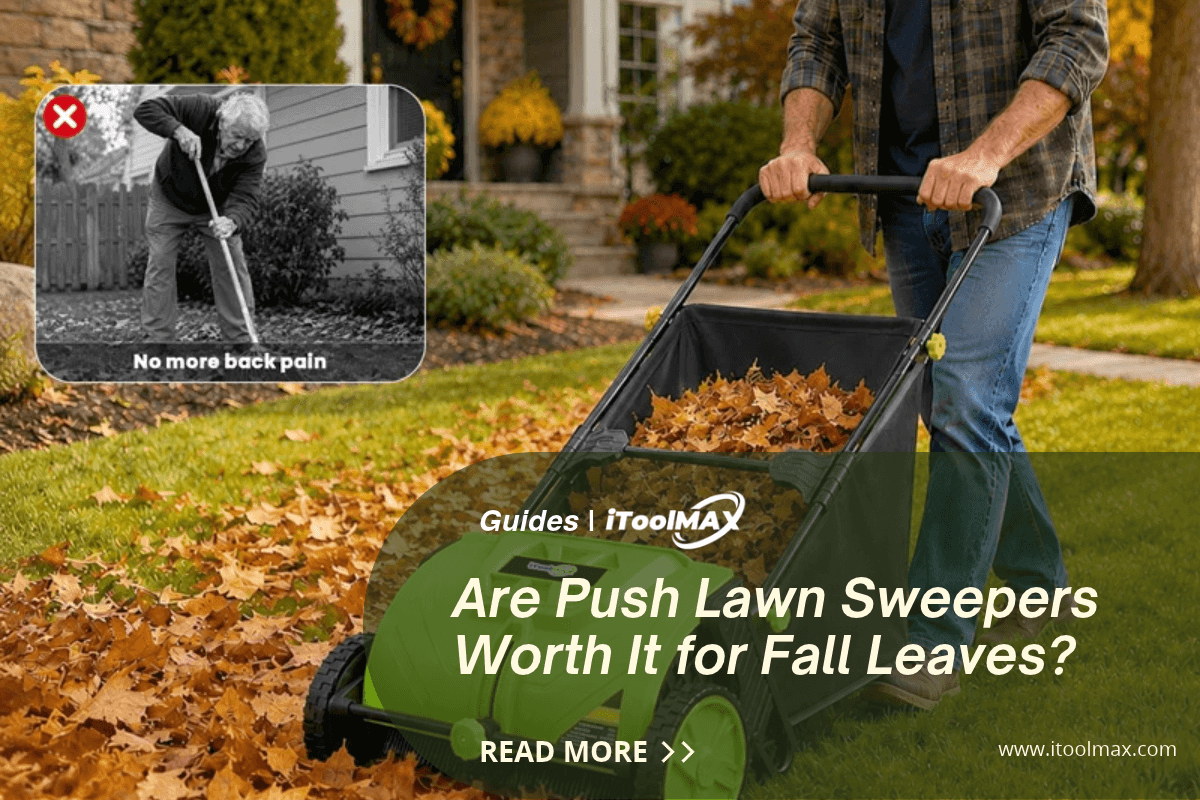
Yes, a push lawn sweeper can be worth buying for a small to medium yard with trees, fairly level grass, and open stretches to sweep. It suits homeowners who regularly bag or compost leaves and want less repetitive raking while remaining comfortable pushing and unloading a manual tool. Whether it makes cleanup easier also depends on your existing equipment and how you handle collected leaves. Here’s how to assess your yard, compare the options, and decide whether a sweeper is worth the investment.
What Is a Push Lawn Sweeper, and How Does It Work?
A push lawn sweeper is a manual yard tool you walk behind to collect leaves, grass clippings, pine needles, and small twigs. It needs no gasoline, batteries, or power cord.
As you push forward, the wheels drive rotating brushes that lift loose debris from the grass into a rear collection bag called a hopper. The sweeper collects leaves without shredding them. You then empty them onto a tarp, into yard-waste bags, or at your compost area.
Pickup depends on how the brushes contact the lawn. Adjustable brush height lets you position them to reach the leaves without dragging heavily through the grass. Brushes set too high can miss debris; brushes set too low make the sweeper harder to push.
Decide If You Need to Collect the Leaves
Collect excess leaves when they form a thick blanket that hides the grass. Scattered leaves can stay on the lawn to decompose, while moderate cover can often be chopped with a mower and returned to the turf.
| What You See | What to Do | How Much to Collect or Keep |
|---|---|---|
| Scattered leaves covering roughly 20% of the lawn | Leave them to settle and decompose. | Collection is usually unnecessary while coverage remains sparse. |
| Leaves covering roughly half the lawn, with grass still visible | Mow them into small pieces that fall between grass blades. | Keep the shredded material if it settles into the turf. |
| A thick layer with barely any grass visible underneath | Remove at least half the leaves, then mulch the remainder with your mower. | Collect more if the remaining material still forms a heavy covering after mowing. |
These percentages are practical reference points. Check dense patches beneath trees separately, even when the rest of the lawn is mostly clear.
After mulching, grass blades should remain exposed, with very little leaf debris sitting on top. If another mowing pass still leaves a heavy covering, collect the surplus for composting or local yard-waste pickup.
Check If Your Lawn Suits a Push Sweeper
Look at the leaves on the ground and the path the machine would follow. Both affect pickup and pushing effort.
Leaf Condition and Grass Coverage
Loose, dry leaves are generally easiest to sweep. Our sweeper also handles lightly damp leaves, though soaked, matted layers may need loosening and additional passes. Schedule collection before leaves settle into a dense blanket.
Leaves resting on top of the grass are easier for brushes to reach than material buried in long, tangled growth. Maintain your lawn at its appropriate mowing height, and spread deep piles into a shallow layer before sweeping. Avoid cutting the grass unusually short just to improve leaf pickup.
Ground Shape, Obstacles, and Access
Open stretches allow steady passes. Roots and hollows can change brush contact, while closely spaced beds create extra turns. On slopes, account for controlling the machine with a loaded hopper and follow the model’s operating limits.
Measure gates and storage entrances against the machine’s overall width, allowing turning room at the ends of your passes. Sweeping width describes the brush path; the frame and wheels may extend beyond it.
Weigh the Pros and Cons of a Push Lawn Sweeper
| What Matters | Advantages | Trade-Offs |
|---|---|---|
| Purchase and Running Costs | Manual operation avoids fuel, charging, and engine servicing costs. | Buying a sweeper adds an expense if your existing tools already handle cleanup. Brushes, wheels, and hopper fabric may eventually need replacement. |
| Comfort and Ease of Use | Walking passes replace repeated rake strokes across open grass. Operation is quieter than an engine or powered blower. | You still push, turn, and unload the machine. Slopes, rough ground, and heavier loads increase the effort required. |
| Gardening and Composting | Collects leaves for a compost pile or reuse elsewhere in the garden, while keeping open lawn areas tidy. | Leaves remain whole and bulky. Shredding them for faster composting adds another step and may require equipment you do not already own. |
| Fit With Other Equipment | Gathers leaves directly into a hopper and works independently of a riding mower. A blower can move leaves from edges into its path. | A rake remains useful between plants and around roots. If your mower already bags leaves effectively, a sweeper may duplicate work your equipment can handle. |
| Environmental Impact | Uses human power, with no engine exhaust or electricity consumed during sweeping. Collected leaves can be composted locally. | A rake offers the same fuel-free operation. Mulching suitable leaves in place also avoids collection bags and transport. |
| Lawn Health | Removes dense leaf cover that blocks sunlight and can smother grass, helping you manage heavy accumulations. | Removing every leaf also removes organic material that could benefit the soil. Keep suitable finely shredded leaves in the turf and collect the excess. |
Count the Work Beyond Pushing
Count pickup, unloading, bagging, and cleanup when judging time savings. A sweeper can simplify gathering leaves, while the distance to your compost pile and the final transfer into bags still affect the whole job.
Stephanie, a customer reviewing our 22-inch push lawn sweeper, describes collecting debris from a yard with many trees, removing and emptying the hopper, then starting again. She also notes, “It does take some muscle.” Her experience highlights two things to plan for: handling the collected load and making repeated unloading stops.

To check the workload in your yard:
- Start with a measured patch. If you can borrow or try a sweeper, mark out 20 by 50 feet, or 1,000 square feet. Record the leaf condition, number of passes, and pickup time.
- Time each unloading trip. Include walking to the unloading point, emptying the hopper, and returning. Place a tarp or collection containers nearby to shorten that route.
- Finish the disposal step. Count the time needed to transfer leaves into approved bags or your compost area, then clear debris from the sweeper before storage.
For example, suppose that 1,000-square-foot patch takes 12 minutes to sweep, three unloading trips take 2 minutes each, and final bagging takes 7 minutes. Pickup, unloading, and bagging would take 25 minutes, with equipment cleanup and storage adding further time. These are illustrative figures, not product test results.
Compare that total with your current routine on a similarly covered area. If unloading and bagging take most of the time, improving the collection point may matter as much as faster pickup.
Compare the Purchase With Your Current Cleanup Method
Compare the extra purchase with the equipment you already own. Include the physical work of gathering, unloading, and moving leaves to their final destination.
| Method | Best Fit | Physical Effort | Additional Purchase Cost | Ongoing Costs |
|---|---|---|---|---|
| Rake and tarp | Small areas, planting beds, and awkward corners | Repeated rake strokes, loading leaves, and pulling the tarp | $0 if both are owned; otherwise purchase the missing items | Replacement tools, disposal bags, and any collection fees |
| Existing mower with bagger | Collecting leaves on accessible, mowable lawn | Walking or riding, depending on the mower; lifting and emptying the catcher | $0 if equipped; otherwise obtain a quote for a compatible bagger | Fuel or electricity, mower maintenance, and disposal supplies |
| Existing mulching mower | Leaf cover that can be finely chopped and left in the turf | Mowing passes; extra passes where leaves accumulate | $0 if equipped; otherwise check the cost of a compatible mulching kit | Fuel or electricity, blade care, and mower maintenance |
| Leaf blower | Moving leaves from edges and gathering scattered material | Carrying and aiming the blower; scooping or loading gathered leaves remains | $0 if owned; our five-speed cordless kit is $136.99 with two batteries and a charger | Charging, eventual battery replacement, and disposal supplies |
| Push lawn sweeper | Repeated collection across accessible lawn | Walking, pushing, turning, and unloading; heavier loads increase effort | $209.99 for our 22-inch model | Wear parts, disposal bags, and any collection fees; no fuel or charging |
Equipment prices are in USD and may change. Include applicable tax and shipping in your budget.
What Tools Pair Well With a Lawn Sweeper?
A Cordless Leaf Blower for Edges and Corners
Leaves along fences, patio borders, and around shrubs need to reach open grass before the sweeper can collect them. Our five-speed cordless leaf blower lets you adjust airflow as you move those leaves into shallow strips along your sweeping route.
Start with a lower speed and increase it only as needed. Spread gathered leaves across the collection path so the sweeper can pass through them without pushing into a deep pile.
An Electric Leaf Mulcher for Collected Leaves
Whole leaves can quickly fill disposal bags or take up composting space. After sweeping, our electric leaf mulcher with a 50-liter collection bag shreds the gathered leaves and catches the processed material for transfer.
Set up the mulcher near your unloading point to reduce carrying between stages. This model is corded, so choose a location with a suitable power supply, remove stones and litter from the collected leaves, and follow the operating instructions for feeding. The pairing is useful when reducing leaf volume is a regular part of your cleanup.
Identify the Conditions That Make a Sweeper Worth Buying
Buy a sweeper when repeated raking across open grass is the job you want to replace. For example, you already blow leaves away from fences and beds, then spend much of each cleanup raking the lawn for composting or collection. A sweeper fits that routine when you can make continuous walking passes, unload nearby, and comfortably handle the machine.
Keep your current equipment if mowing already finishes the cleanup. If your mower leaves fine leaf pieces within the turf, collection may be unnecessary. If its bagger collects the excess comfortably, another collection tool offers less benefit. A few remaining patches around shrubs may only need a rake.
Try a sweeper before buying if handling is the uncertainty. If possible, borrow one and test your usual route, including turns, slopes, and unloading. If carrying leaves or filling disposal bags remains the hardest stage, improve the unloading arrangement before spending on another pickup tool.
Finally, divide the purchase price by the number of cleanups you expect to use it for. At $209.99, 20 planned cleanups work out to about $10.50 each, before wear parts or disposal costs. Decide whether replacing the raking stage is worth that expense, and confirm gate clearance and storage space before ordering.
Common Questions About Lawn Sweeper Uses and Maintenance
Q1. Can a Lawn Sweeper Pick Up Acorns and Pine Needles?
The iToolMax sweeper is designed to collect pine needles along with leaves and light yard debris. Acorn pickup varies by model and surface. If nuts are your main cleanup problem, ask about that specific use before choosing a lawn sweeper for leaves.
Q2. Can I Use a Lawn Sweeper for Grass Clippings?
Yes, a model rated for clippings can collect loose material after mowing. Small, evenly distributed clippings can usually remain on the lawn to decompose. Sweeping is useful for surplus material you want to remove; damp clumps may need breaking apart first.
Q3. Is a Lawn Sweeper the Same as a Dethatcher?
No. A sweeper gathers loose surface debris. A dethatcher works into the tightly interwoven layer between the green grass and soil. University of Minnesota Extension’s thatch guidance explains treatments such as vertical mowing. Lowering sweeper brushes does not replace a dethatcher’s tines.
Q4. Should I Choose a Push or Tow-Behind Lawn Sweeper?
A push model suits walking routes and areas where maneuvering a tractor is inconvenient. A tow-behind model may suit extensive open ground if you own a compatible riding mower or lawn tractor. Account for hitch compatibility and turning space, along with collection capacity.
Q5. What Replacement Parts Should I Check Before Buying?
Ask about brushes, hopper fabric, wheels, and drive components for the exact model. Confirm how to order replacements and which repairs owners can handle. Access to these parts matters when you plan to use the machine through several leaf seasons.
Delen:
Hoe elektrische tuingereedschappen het werk in de tuin gemakkelijker en milieuvriendelijker maken